
One of the common questions I hear from clients is:
"Should I buy a home or invest the money instead?"
Like many financial questions, the answer isn't as simple as choosing one over the other. It depends on your goals, your discipline, your lifestyle, and—perhaps most importantly—where you buy your home.
To illustrate this, I built a hypothetical 50-year comparison using one of the most successful housing markets in the country: Menlo Park, California.
The Scenario
Imagine two individuals beginning their financial journey in 1976. Both have identical incomes, the same savings, and the same opportunities.
One chooses to purchase a home in Menlo Park. The other rents and invests using a diversified target-date portfolio that begins heavily invested in stocks and gradually becomes more conservative over time.
The Homeowner
Over five decades, Menlo Park became one of the most desirable communities in Silicon Valley. Fueled by the explosive growth of the technology sector, home values appreciated dramatically.
Our homeowner benefits from:
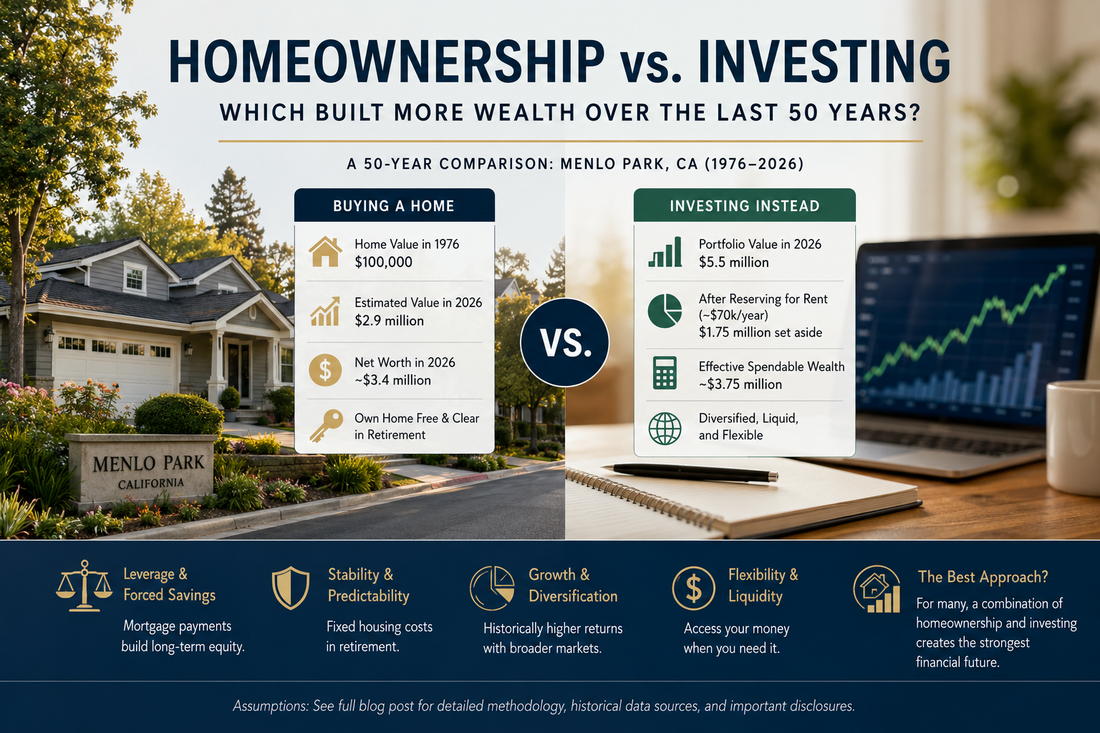
Using reasonable historical assumptions, the home grows from approximately $100,000 to nearly $2.9 million.
After accounting for modest additional investments over the years, the homeowner's estimated net worth reaches approximately $3.4 million.
The Investor
Instead of purchasing a home, the investor rents and invests consistently.
Rather than using a static 60/40 portfolio, the analysis assumes a target-date approach:
This mirrors how many professionally managed retirement funds are designed today.
Assuming disciplined investing over the full 50 years, the investment portfolio grows to approximately $5.5 million.
However, unlike the homeowner, the investor continues paying market rent throughout retirement.
After reserving enough assets to generate approximately $70,000 per year for future housing expenses, the investor's effective spendable wealth is estimated at approximately $3.75 million.
The Results
At first glance, the investor appears to finish ahead.
But the comparison is much closer than many people expect.
Strategy Estimated Spendable Wealth
Menlo Park Homeowner ~$3.4 million
Disciplined Target-Date Investor ~$3.75 million
The difference is surprisingly small considering that one strategy relied almost entirely on a single home while the other relied on a globally diversified investment portfolio.
The Bigger Lesson
The purpose of this comparison is not to declare a winner.
Instead, it highlights an important truth:
A home is not just an investment.
It is also:
Likewise, investing offers advantages that real estate cannot:
A Critical Caveat
Menlo Park is an extraordinary example.
Few housing markets have experienced appreciation comparable to Silicon Valley over the past half century. Buying in Menlo Park in 1976 turned out to be an exceptional investment, but that outcome could not have been predicted with certainty at the time.
Likewise, not every investor maintains the discipline to consistently invest "the difference" month after month for decades. Many intend to do so but never follow through.
My Perspective
After reviewing the data, I don't believe this exercise proves that one strategy is universally superior.
Instead, it reinforces a principle I often share with clients:
Financial success rarely comes from choosing between homeownership and investing. It comes from thoughtfully combining both.
For many families, owning an appropriately priced home while consistently investing in a diversified portfolio provides the best balance of growth, stability, flexibility, and long-term financial security.
The objective isn't to maximize one asset. It's to build a resilient financial life capable of supporting your goals through every stage of life.
Disclaimer: This analysis is hypothetical and intended for educational purposes only. It uses reasonable historical assumptions but does not represent actual investment performance or guarantee future results. Investment returns, housing appreciation, taxes, inflation, maintenance costs, and personal circumstances vary over time. Before making financial decisions, consult with a qualified financial professional regarding your specific situation.
"Should I buy a home or invest the money instead?"
Like many financial questions, the answer isn't as simple as choosing one over the other. It depends on your goals, your discipline, your lifestyle, and—perhaps most importantly—where you buy your home.
To illustrate this, I built a hypothetical 50-year comparison using one of the most successful housing markets in the country: Menlo Park, California.
The Scenario
Imagine two individuals beginning their financial journey in 1976. Both have identical incomes, the same savings, and the same opportunities.
- Initial savings: $20,000
- Home purchase price: $100,000
- Mortgage: $80,000, 30-year fixed
- Investment horizon: 50 years
One chooses to purchase a home in Menlo Park. The other rents and invests using a diversified target-date portfolio that begins heavily invested in stocks and gradually becomes more conservative over time.
The Homeowner
Over five decades, Menlo Park became one of the most desirable communities in Silicon Valley. Fueled by the explosive growth of the technology sector, home values appreciated dramatically.
Our homeowner benefits from:
- Long-term appreciation
- Mortgage leverage
- Tax advantages
- Forced savings through mortgage payments
- Housing stability
- A fully paid-off home in retirement
Using reasonable historical assumptions, the home grows from approximately $100,000 to nearly $2.9 million.
After accounting for modest additional investments over the years, the homeowner's estimated net worth reaches approximately $3.4 million.
The Investor
Instead of purchasing a home, the investor rents and invests consistently.
Rather than using a static 60/40 portfolio, the analysis assumes a target-date approach:
- Younger years: approximately 90% stocks
- Mid-career: gradually increasing bond exposure
- Retirement: approximately 50% stocks and 50% bonds
This mirrors how many professionally managed retirement funds are designed today.
Assuming disciplined investing over the full 50 years, the investment portfolio grows to approximately $5.5 million.
However, unlike the homeowner, the investor continues paying market rent throughout retirement.
After reserving enough assets to generate approximately $70,000 per year for future housing expenses, the investor's effective spendable wealth is estimated at approximately $3.75 million.
The Results
At first glance, the investor appears to finish ahead.
But the comparison is much closer than many people expect.
Strategy Estimated Spendable Wealth
Menlo Park Homeowner ~$3.4 million
Disciplined Target-Date Investor ~$3.75 million
The difference is surprisingly small considering that one strategy relied almost entirely on a single home while the other relied on a globally diversified investment portfolio.
The Bigger Lesson
The purpose of this comparison is not to declare a winner.
Instead, it highlights an important truth:
A home is not just an investment.
It is also:
- A place to live
- A hedge against rising housing costs
- A source of financial stability
- A form of forced savings
- A leveraged asset that most families could not otherwise access
Likewise, investing offers advantages that real estate cannot:
- Greater diversification
- Daily liquidity
- Lower concentration risk
- Flexibility
- Historically higher expected long-term returns across broad markets
A Critical Caveat
Menlo Park is an extraordinary example.
Few housing markets have experienced appreciation comparable to Silicon Valley over the past half century. Buying in Menlo Park in 1976 turned out to be an exceptional investment, but that outcome could not have been predicted with certainty at the time.
Likewise, not every investor maintains the discipline to consistently invest "the difference" month after month for decades. Many intend to do so but never follow through.
My Perspective
After reviewing the data, I don't believe this exercise proves that one strategy is universally superior.
Instead, it reinforces a principle I often share with clients:
Financial success rarely comes from choosing between homeownership and investing. It comes from thoughtfully combining both.
For many families, owning an appropriately priced home while consistently investing in a diversified portfolio provides the best balance of growth, stability, flexibility, and long-term financial security.
The objective isn't to maximize one asset. It's to build a resilient financial life capable of supporting your goals through every stage of life.
Disclaimer: This analysis is hypothetical and intended for educational purposes only. It uses reasonable historical assumptions but does not represent actual investment performance or guarantee future results. Investment returns, housing appreciation, taxes, inflation, maintenance costs, and personal circumstances vary over time. Before making financial decisions, consult with a qualified financial professional regarding your specific situation.









 RSS Feed