
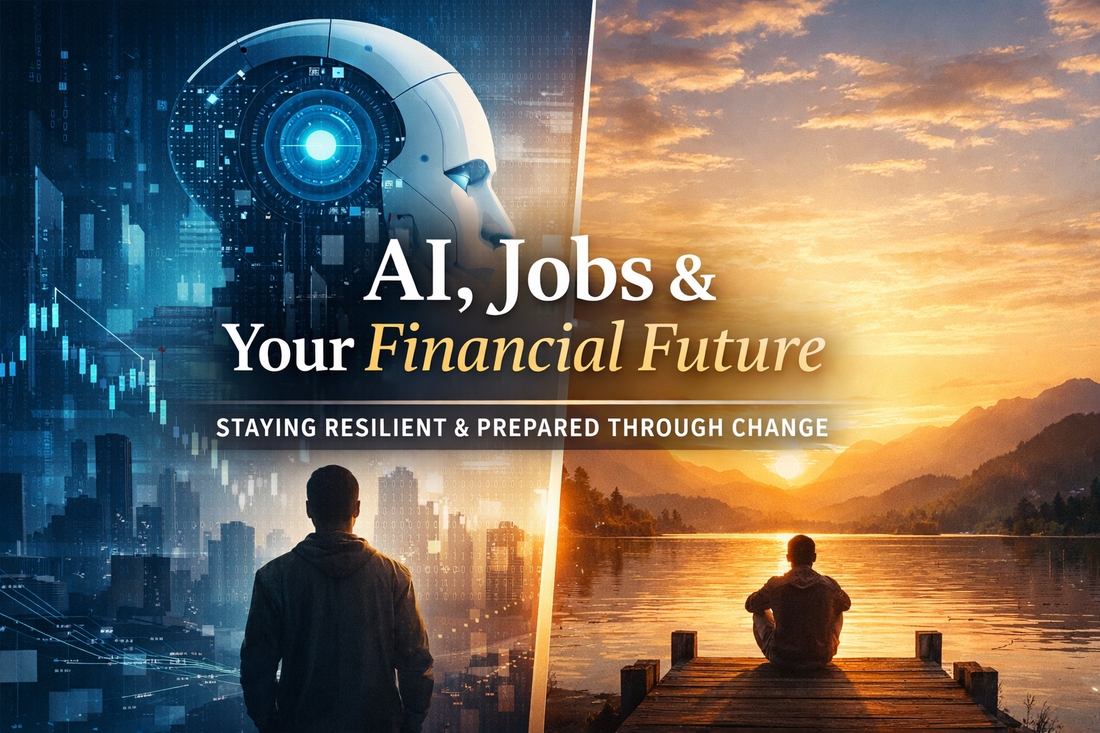
Lately, I’ve seen more conversations — and anxiety — around AI and job security, especially in tech and professional services.
Some articles go as far as predicting mass white-collar displacement within a few years. One widely shared example is a speculative scenario from Citrini Research that imagines a sharp labor shock by 2028.
Whether or not those timelines play out exactly as written misses the deeper point.
The real risk isn’t that AI suddenly replaces everyone.
The real risk is income uncertainty arriving faster than people emotionally prepare for it.
Technological change doesn’t collapse systems — it stresses them
Historically, innovation doesn’t eliminate work overnight.
It reshapes roles, compresses margins, and creates uneven pressure.
What changes first isn’t employment itself — it’s:
- confidence
- predictability
- long-term planning behavior
That’s where damage quietly accumulates.
The financial danger isn’t job loss — it’s delayed adaptation
I’ve watched this pattern repeat across cycles:
People don’t make their worst financial decisions when something bad happens.
They make them when they wait too long to acknowledge change.
They assume:
- “This will pass quickly”
- “I’ll figure it out later”
- “I don’t want to overreact”
Then urgency shows up all at once.
And urgency leads to:
- rushed withdrawals
- selling long-term assets at the wrong time
- decisions driven by fear instead of clarity
Good planning doesn’t predict the future — it absorbs it
AI headlines are not a call to panic.
They’re a reminder of something simpler and older:
Resilience beats prediction.
That means:
- prioritizing runway over optimization
- building flexibility before it’s needed
- separating identity from income
- making space to adapt without dismantling everything
A strong financial plan isn’t built for one future.
It’s built to survive many.
The conversation we should be having
Instead of asking:
“Will AI replace my job?”
A more useful question is:
“If my income became less predictable for a period of time, would my life still feel stable?”
That question cuts through hype and gets to what actually matters.
A closing thought
Every major technological shift feels existential while you’re living inside it.
In hindsight, the people who fared best weren’t the ones who guessed right --
they were the ones who stayed grounded, liquid, and adaptable.
AI will change how we work.
It doesn’t have to dismantle how we live.
Calm beats clever.
Preparation beats panic.
And clarity always beats noise.
 RSS Feed